Car keys · Toronto
Spare Car Key Duplication
The blade on the everyday key has gone shiny and thin along one edge, and lately it needs a wiggle before the ignition catches.
In plain words
A vehicle used by more than one person, such as a shared family car, a small business van or a vehicle looked after by a caretaker, works better with a key for each regular driver rather than one ring changing hands. Spare key duplication from the working original gives every driver an independent, fully tested key: matched blade, matched chip or remote code, and confirmed operation in every door and the ignition before anyone leaves. Keeping a record of how many keys exist and who holds each one also makes accounting for all of them simpler later on.
How the visit goesThe proximity fob has ridden in a pocket for years, the range feels shorter than it used to, and a dashboard warning mentioned a battery a while back. Nobody has sorted out what happens on the day it finally goes dark.
Spare Car Key Duplication
How the visit goes
Deciding between copying and programming the chip
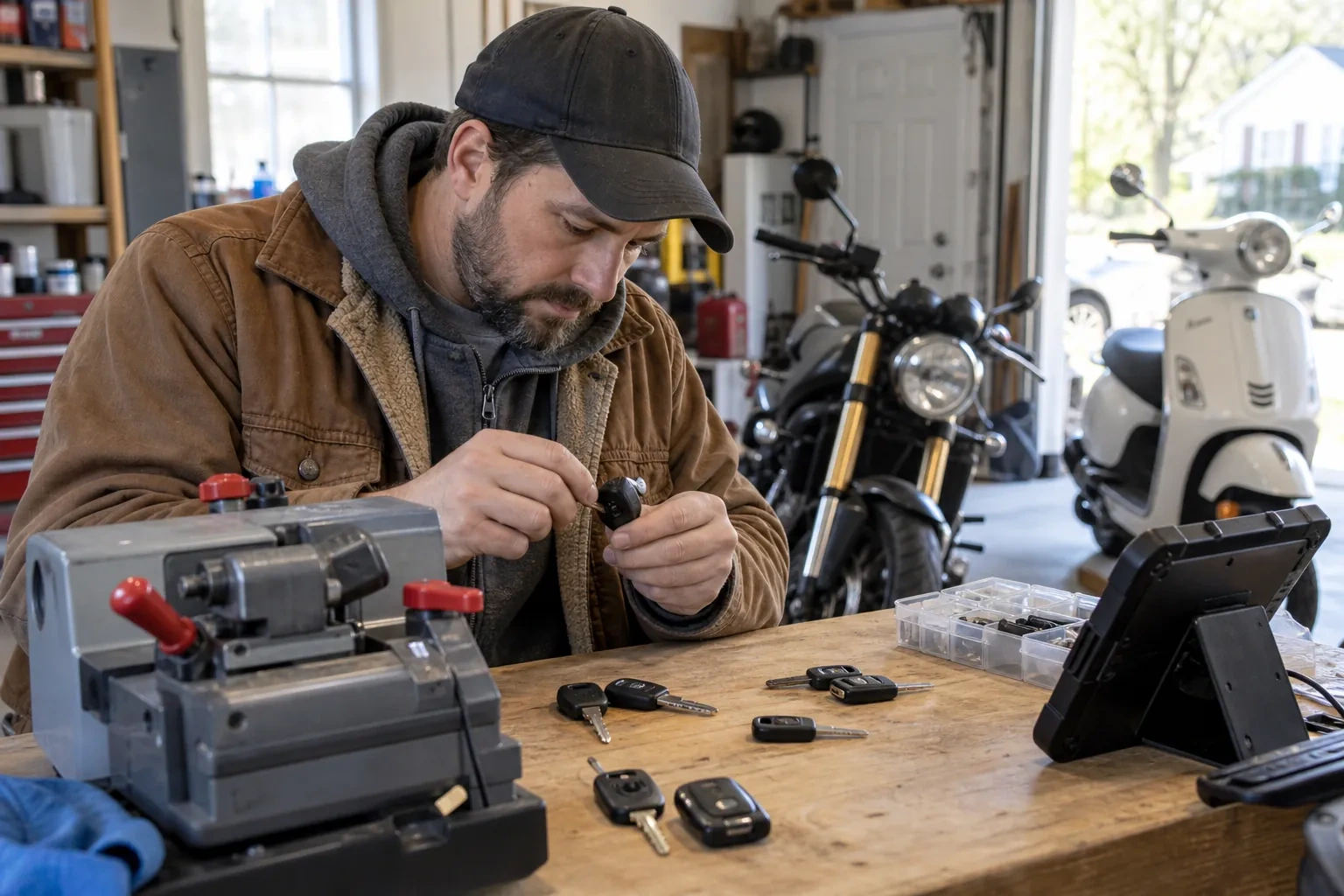
Some immobilizer systems allow a new chip to be cloned directly from the working key's own data, which lets a matching second key be produced from the original. Other systems, including some that use rolling codes or added cryptography, call instead for connecting to the vehicle through its diagnostic port and enrolling a freshly coded chip as an additional authorized key rather than a copy of the first. The locksmith identifies which method the specific vehicle and transponder support before starting the work, since the two routes use different tools and take different amounts of time at the vehicle.
Giving the new key its electronic identity
A cut blade alone will turn the lock but will not start a car with an immobilizer, so the new key also needs the chip data the vehicle expects. Where the transponder supports it, the original's data is read and cloned onto a fresh chip directly, sometimes with the help of vehicle-specific data pulled from the car itself. Where cloning is not supported for that application, the locksmith instead connects to the vehicle's diagnostic port and walks the car's own security module through enrolling the new chip as an additional valid key, a process that can take longer but produces a key the vehicle recognizes on its own rather than one imitating another.
Two keys, both proven
The visit ends with two keys that have each been tested on their own: every door, the trunk or hatch, the ignition or start button, and any remote functions. Neither key is a backup that has only been assumed to work, and neither is treated as the senior copy. It is worth deciding on the spot which key rides on the daily ring and which goes into storage, and writing that decision down somewhere the household will actually check later, such as a shared note or a label on the ring itself, rather than trusting memory a year from now.
Spare Car Key Duplication
In the van
Deburring file
Chip cloning tool
Key gauge and calipers
Coin-cell fob battery
Remote-head key shell
Spare Car Key Duplication
What affects the quote
Whether remote functions are included
A spare limited to the blade and chip that unlock and start the vehicle involves less programming than a full match of every remote button the original carries, and the quote follows whichever is chosen.
How many keys are needed
Making one spare is a smaller job than producing several matching keys for a whole household or a small fleet in the same appointment, and the quote reflects how many are wanted.
Which key system the vehicle uses
A plain mechanical blade, a transponder key, a remote-head key and a proximity fob each call for different tools and different amounts of time, so identifying the system early shapes the whole quote before any cutting or programming starts.
What to have ready
- Has a key ever gone missing that was never accounted for?
- Does the key have buttons, a chip, or neither?
- Do you currently have one working key, or more than one?
Spare Car Key Duplication: questions
QuestionsWhat is a relay attack, and does it matter for my spare?
A relay attack is when nearby equipment picks up a proximity fob's signal from inside a house and relays it to a vehicle parked outside, tricking the car into thinking the key is close enough to unlock or start. It matters for every fob in the household, spare included, which is why storing any proximity key in a signal-blocking pouch when it is not being carried is worth doing for all of them.
How is a proximity or smart key different to duplicate compared to a regular key?
A proximity key usually has no blade to trace, so the process is almost entirely electronic: pairing a new fob to the vehicle's receiver and enrolling it through the diagnostic connection so the car recognizes it as an additional key. Many still hide a small mechanical blade inside the shell for emergencies, and that blade is cut separately to match the door lock, even though it is rarely used day to day.
What happens if I only have one key and it is for a car I just bought?
This is a common and straightforward call. The locksmith works from the single existing key and the vehicle itself, identifying the blade profile and reading or matching the chip, then testing the result on its own before the visit ends. It is also a good moment to confirm how many keys the car's history suggests should exist, since a private sale sometimes changes hands with an unknown key already out of circulation.
Related services
- Car Key ReplacementMinus twenty outside, the fob button does nothing, and the door keyhole has a crust of road salt over it because you have not used a metal key in that car since the day you bought it.
- Key Fob ProgrammingButtons on the fob still light up and the remote still clicks, but the vehicle refuses to start even with the fob sitting in the cupholder.
- Transponder Key ProgrammingThe new key slides into the ignition and turns exactly the way the old one did, but the engine only cranks.